Keywords
police
Police Performance Measurement
academic literature
Police Performance Measurement
academic literature
How to Cite
Police Performance Measurement in International Literature, with special focus on the Indicators of Legitimacy and Trust . (2019). Academic Journal of Internal Affairs, 67(6), 7-29. https://doi.org/10.38146/BSZ.2019.6.1
Abstract
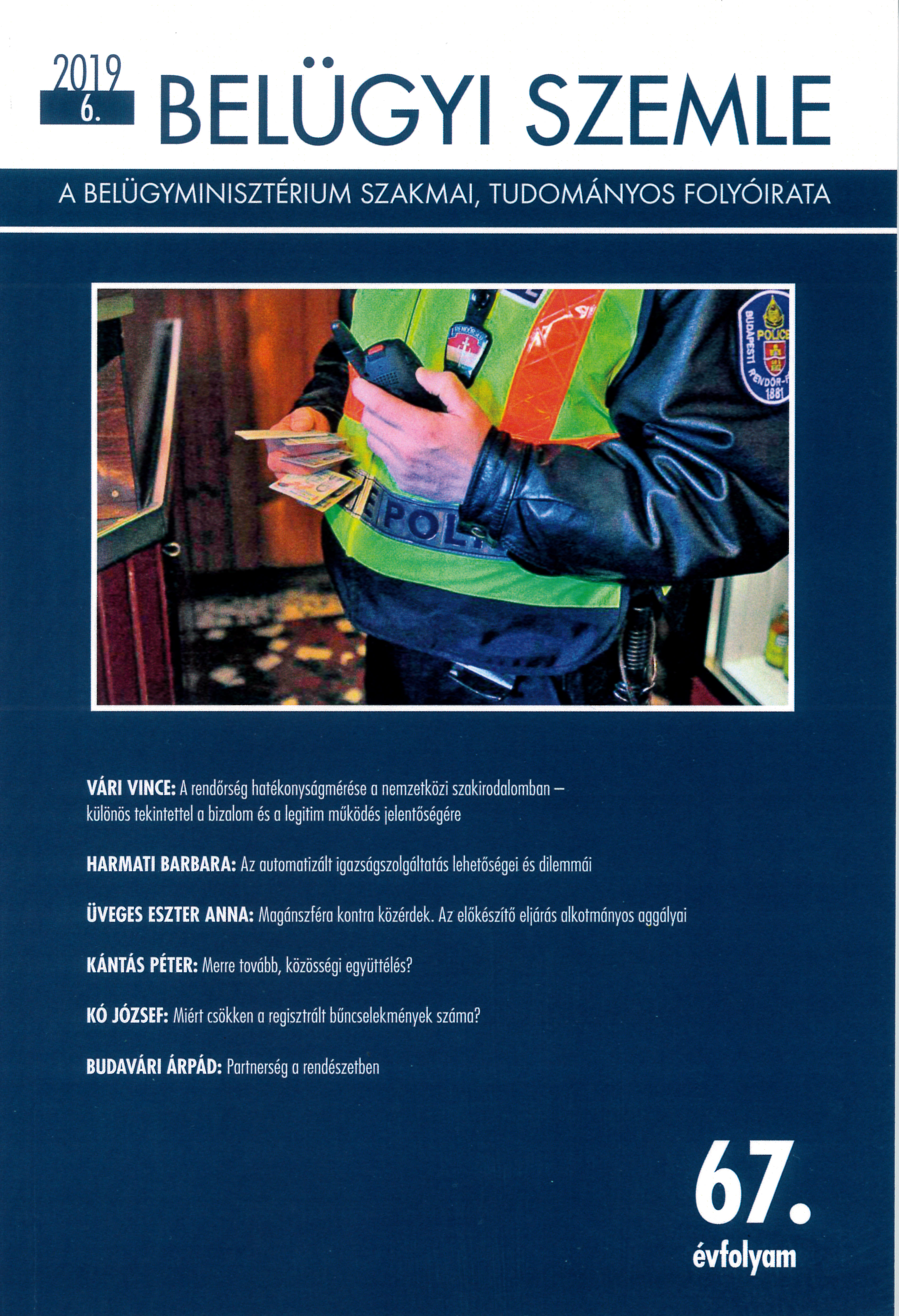
The present home model of efficiency measurement of the Police is mostly based on efficiency of criminal cases, i.e. quantity calibrated. But our world changed a lot in the past decades, in an information society the work of Police should not be assessed by statistical results but rather how to ascertain in the most authentic way the real social effects of their activities (how high is the satisfaction factor, the confidence and the recognition in the society). Government of modern democracies have increasingly the demand that the actual social effects of Police work should be gauged by scientific exactness. The author gives a summary about this research.
Downloads
Download data is not yet available.
Similar Articles
- Ladislav Ignyes, Jozef Balga, Characterization of Slovak police legislation , Academic Journal of Internal Affairs: Vol. 72 No. 6 (2024)
- László Korinek, Local Self-Government Police? , Academic Journal of Internal Affairs: Vol. 72 No. 5 (2024)
- Vince Vári, Relationship between trust in the police and the effectiveness of the police , Academic Journal of Internal Affairs: Vol. 69 No. 6. ksz. (2021): Különszám
- Zoltán Balla, Ceterum censeo, let’s not talk about law enforcement yet , Academic Journal of Internal Affairs: Vol. 72 No. 6 (2024)
- Sándor Horváth, Batons and raids: policing poverty by the communist police , Academic Journal of Internal Affairs: Vol. 60 No. 7-8 (2012)
- Pál Kardos, Ferenc Füle, Zsolt Lippai, Legal obstacles to effective action in the context of the removal of end-of-life vehicles from public roads , Academic Journal of Internal Affairs: Vol. 72 No. 7 (2024)
- József Beregnyei, The relation between the supply of the executive staff of the law enforcement organisations (police) and certain age group characteristics , Academic Journal of Internal Affairs: Vol. 67 No. 9 (2019)
- Sándor Dragon, Ivett Nagy, Gergely Péter Pászti, Gábor Németh, József Beke, Zita Veprik, Tamás Richárd Pék, International Law Enforcement Observer IV. , Academic Journal of Internal Affairs: Vol. 69 No. 12 (2021)
- Gergely Mogyoródi, Acceptance process for policemen as reflected in the characteristics of modern police , Academic Journal of Internal Affairs: Vol. 66 No. 4 (2018)
- Violetta Rottler, Sándor Kovács, The Beginning of Private Security and the Development of the Hungarian Private Security Sector up to the First Legal Instrument with the Status of Law , Academic Journal of Internal Affairs: Vol. 70 No. 3 (2022)
You may also start an advanced similarity search for this article.
Most read articles by the same author(s)
- Szabolcs Mátyás, Miklós Tihanyi, Vince Vári, Survey on Safety and Perceptions of Security in Budapest's 'Party District' , Academic Journal of Internal Affairs: Vol. 73 No. 1 (2025)
- Vince Vári, Relationship between trust in the police and the effectiveness of the police , Academic Journal of Internal Affairs: Vol. 69 No. 6. ksz. (2021): Különszám
- Szabolcs Mátyás, János Sallai, Tibor Szarvák, Miklós Tihanyi, Vince Vári, Towards a new paradigm: trust and security , Academic Journal of Internal Affairs: Vol. 67 No. 2 (2019)
- Richárd Nagy, Vince Vári, New ways in asset recovery , Academic Journal of Internal Affairs: Vol. 69 No. 4 (2021)
- Vince Vári, Crimes related to new psychoactive substances in rural segregates of Miskolc in Hungary , Academic Journal of Internal Affairs: Vol. 70 No. 2. ksz. (2022): Special Issue
- Vince Vári, The principle and logic of allocating investigative resources in the Hungarian police , Academic Journal of Internal Affairs: Vol. 73 No. 12 (2025)
